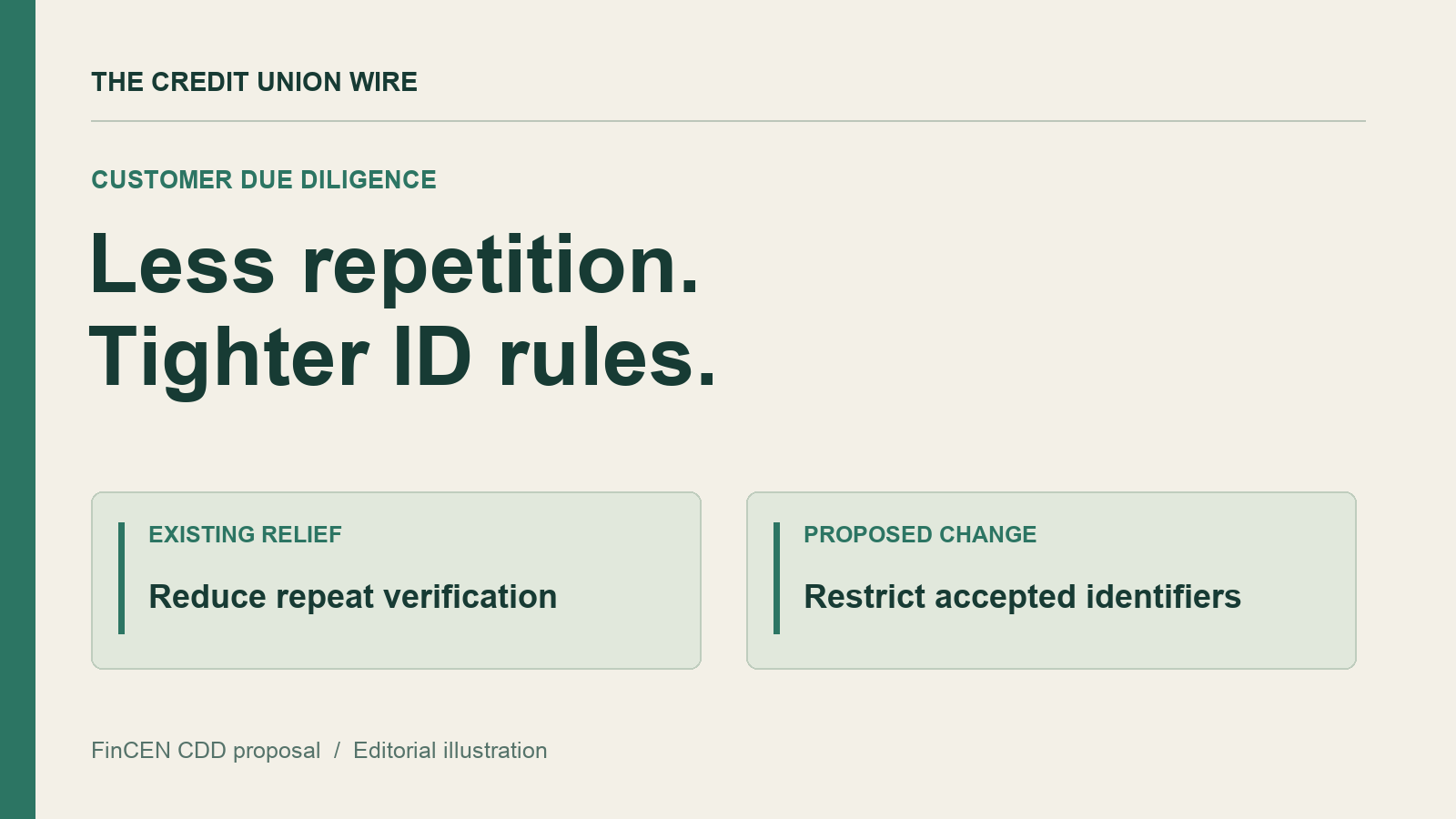
A shorter compliance checklist can still make a business account harder to open. The FinCEN CDD proposal would reduce repetitive beneficial-owner checks while tightening which identification numbers credit unions can accept.
That combination deserves more attention than the promise of regulatory relief. For credit unions serving business members, the proposal separates work they can already stop repeating from identification changes that remain unsettled.
The Financial Crimes Enforcement Network announced the proposal on November 17. NCUA encouraged credit unions to comment, citing the Bank Secrecy Act's application to all federally insured credit unions. The underlying proposed rule reaches beyond that announcement: it addresses repeat verification, ITINs, immigration-related information and third-party data.
The relief already exists
The FinCEN CDD proposal would write existing relief into the regulation. It would not create that relief for the first time.
FinCEN's February 13 exceptive order already allows covered institutions to stop identifying and verifying a legal entity's beneficial owners at every additional account opening. Identification and verification remain required at the first account, when known facts reasonably call previously obtained information into question, and as needed under ongoing risk-based due diligence.
The February order leaves institutions discretion to continue checking at every account opening. The proposed rule would preserve that choice. Less repetition is permitted; it is not compulsory, and ongoing due diligence remains part of the obligation.
That limits what the November announcement changes immediately. The account-opening relief predates this proposal. Codifying it would make the relief part of the regulation, while the proposed restrictions on identifying numbers would change what institutions can collect to satisfy a different requirement.
What the FinCEN CDD proposal changes about ITINs
The proposed rule would move core identification requirements from the optional certification form into the regulatory text. Institutions would collect a beneficial owner's name, date of birth, address and qualifying identifying number.
For a U.S. person, the specified number would be a Social Security number. For a non-U.S. person, permitted alternatives would include a passport number and issuing country, an alien identification card number, or a qualifying government-issued document number. An Individual Taxpayer Identification Number would not satisfy the proposed identifying-number requirement.
The distinction is about identifying beneficial owners of legal entity members. This proposal does not establish a blanket prohibition on personal accounts for ITIN holders. FinCEN explicitly recognizes that its proposed CDD requirements could differ from the information permitted under customer identification program rules, and asks how institutions would manage that difference.
The distinction matters because a business owner's identification and an individual's personal account can fall under different collection requirements. The FinCEN CDD proposal itself identifies that potential divergence rather than treating the requirements as interchangeable.
The IRS says ITINs serve federal tax purposes and do not provide immigration status or work authorization. It also says eligible applicants can obtain an ITIN regardless of immigration status. An ITIN alone therefore does not establish that someone lacks lawful status.
Risk-based requests still need a reason
Another provision would expressly allow institutions to obtain additional beneficial-owner information when warranted by risk indicators or supervisory concerns. That could include information relevant to lawful immigration status and U.S. employment authorization.
The proposed language connects those requests to risks such as fraud, identity misrepresentation, sanctions evasion or other illicit financial activity. It does not direct a blanket immigration-status check on every member.
FinCEN nevertheless gives consequential examples in its explanation. Foreign-government identification presented by a beneficial owner residing in the United States could, it says, be judged a heightened-risk situation. The agency leaves institutions to assess those circumstances through risk-based practices.
A foreign passport could therefore remain a permitted identifying document while also prompting further inquiry in circumstances the institution judges risky. That tension sits inside the proposal itself. FinCEN asks whether the rule strikes an appropriate balance between mandatory information collection and institutional discretion.
A vendor result would still need certification
The FinCEN CDD proposal would expressly permit third-party sources for beneficial-owner information. At the first account opening, the person opening the account for the entity would still have to certify its accuracy to the best of their knowledge. Buying data would not remove that step.
For certain ongoing reviews, institutions could rely on previously certified information after obtaining oral or written confirmation that it remains accurate. Records of the certification or confirmation would still matter.
The access question remains open
Treasury says comments are due 60 days after Federal Register publication, under docket FINCEN-2026-0298. As of November 18, the public-inspection copy schedules publication for November 19 and still contains a placeholder deadline. The comment period is tied to publication, rather than the November 17 announcement.
FinCEN specifically asks whether the ITIN restriction creates compliance challenges, whether additional verification could be an alternative, and whether a lawfully present individual might lack another permitted identifier. The agency expects ITIN holders lawfully present and authorized to work to have alternatives, such as a foreign passport or alien identification card. Its questions leave room to test that expectation.
The proposal also asks whether its trigger for revisiting ownership information needs clarification. A change in ownership may concern the continuing accuracy of a record, FinCEN notes, rather than the reliability of information that was correct when collected.
The FinCEN CDD proposal promises more focused compliance. Whether that also means easier access for a business member depends on a question the agency has left open: what happens when the owner has an ITIN and no other permitted identifier?
Prepared with AI-assisted research and drafting from linked primary sources. Publication remains subject to the publisher's review.